
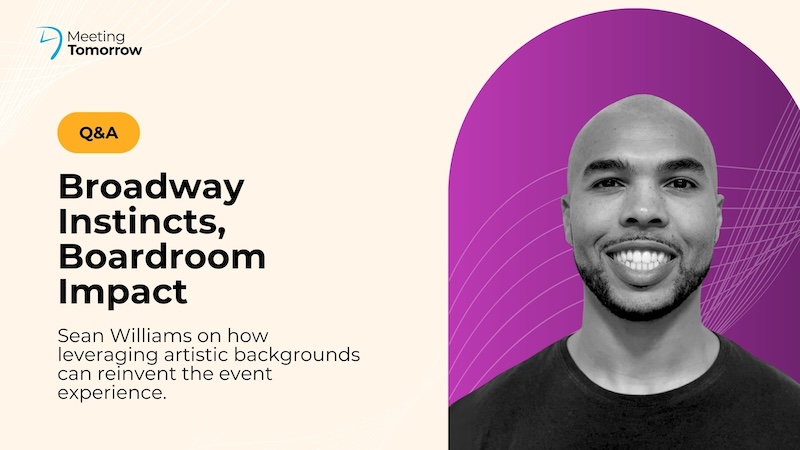
Before he was helping clients envision and create incredible events, Sean Williams was lighting up stages around the world as a professional dancer, singer, and performer. These days, he’s a Strategic Account Executive, but his background in the performing arts still shows up in everything he does. Whether he’s brainstorming a creative solution or talking through logistics, Sean brings a unique mix of energy, creativity, and problem solving to every conversation.
We sat down with Sean to hear more about how his creative roots influence his events today. He talks about why events remind him of solving a puzzle, how his performing career gave him a deep love of collaboration, and why he always approaches conversations with one goal in mind: helping people.
Let’s just start with your career story. How did your first career as a professional dancer and performer shape you?
It definitely made me well cultured. It took me everywhere — I went from just living in London to going on tours around the world. I think there’s only a few places I haven’t been around the globe, just thanks to being in that industry.
When I say cultured, I mean it in the respect that it led me to cross paths with so many people and personalities and different approaches to life. From on stage and behind the stage, working with directors, choreographers, film stars, or artists — you literally work with all different walks of life. That helped me have a well-rounded approach to what the world is, and how everyone’s culture is different and how amazing it is in all aspects of life.
What an amazing life shaping time. In what ways does this era in your life approach how you work with clients today in your career now?
My major was actually in musical theater. I’ve seen how shows are created from all sides, and I feel like it taught me to really listen to the details. Whenever I’m learning something new, you have to really pay attention to all the little moves, all the little inflections, on how you perform something.
So when I’m listening to someone, I’m really attentive to what they’re saying but what they’re actually conveying as well. For example, if I ask someone, “How’s your day?” and they say, “It’s good,” I always pick up on if they aren’t actually having a good day from how they say it, their tone and body language. Part of it is just my nature, but I think my background made me very perceptive.
That’s helping my day-to-day when I’m talking to new clients or coming across new opportunities, and just being a good listener and seeing what we can do here to help. Hearing what they are saying, and also being inquisitive on what they actually need from me.
Of course, conferences and corporate events are very different from Broadway. But what parallels do you see between corporate events and the types of performances from your background?
An event is a performance, no matter the setting. Whether it’s a really big Broadway show or a corporate conference, the same principles apply: there’s an audience, a message, and a need to deliver it clearly and memorably.
From sound to visuals to timing, every detail matters because people remember when things go wrong—and that’s why we work so hard to get it right.
One thing I always do is put myself in the client’s shoes. The moment we connect, we’re a team. I start by asking, “How can I help today?” It’s about helping people pull off an important moment. I try to approach each project with curiosity and creativity. I’ll say, “You mentioned this—have you considered that?” and often they’ll respond, “That’s a great question—I hadn’t thought of that.” It becomes a collaborative process, and that’s where the magic happens.
You’re known for being a great problem solver. What is interesting or fulfilling about a complex event coming your way?
Honestly, it’s that same satisfaction as completing a puzzle. The best way to sum it up is I find puzzles so fun, they’re just entertaining. Learning choreography is like a puzzle.
And it’s kind of like that same pathway in my mind when I’m figuring out something complicated — it’s figuring out what parts need to go where. How do we make this flow? If there’s something I don’t know, I’m always asking all the technical reasons to our team here internally — why are we adding this? What’s the purpose of this? I like to know how things work and why they’re there, it just makes it clearer and helps me pass that knowledge onwards to clients too.
When I get something really complicated, it’s like, let’s make this as simple as possible without having any issues, so it’s technically flawless but also cohesive. That’s what I love and it feels exciting.
It’s great when you find work that gels with exactly how your brain works. Some of these events can feel high stakes. How do you deal with stress in a high pressure role?
I teach performing arts on the side because my daughter goes to a performing arts studio. Something I found myself saying to the girls I was teaching the other day is like, “Hey, remember to have fun, right?”
I would be very surprised if there’s anyone out there who can say true stress helped them do better. Okay, you can stress the whole week, but it didn’t change anything other than just put you in a bad mood the entire time and cause unnecessary worry! Staying calm lets you think clearly, lets you relax and put your best step forward and be confident in your choices. Breathe and pause for a second, because what’s the worst that can happen? You calm yourself down and honestly do better.
Lastly, prioritizing time for yourself to either take a walk and get fresh air, or just making time to stretch for 5-15 minutes, will increase your blood flow and get more oxygen to your brain. Ultimately, revitalizing your brain and improving your thinking.
What advice would you give to someone coming from a similar creative background who is considering client facing work?
Just go for it. Don’t hold yourself back. You’re most likely more qualified than you believe you are. Given that if you’re coming from a creative background, people love and appreciate that. Entering the business world does have that kind of stigma to it that everything’s very professional and shirt-and-tie formal.
Yes, that is an element of professionalism, but it doesn’t always have to be formal. I think having an engaging personality helps you better connect with people. So, I’d say 100% go for it. There’s nothing holding you back.
What is one thing you hope every client takes away after working with you?
That’s a great question. I hope they take away peace of mind. That they leave our conversation feeling that they were heard, they were helped, and they’ve made a friend.
That is so nice, and definitely what clients are taking away. Ok last question, since you mentioned your early musical theater background, I have to know: Do you have a favorite musical?
I would say it was Thriller Live on the West End, and I actually played the lead character, Michael Jackson. It was the first Michael Jackson show that came out anywhere. [Laughs] I had a Jheri curl! Good memories.